One Earth: Two Futures
We developed a comprehensive Euro-style board game that blends strategic depth, emergent play, and world-building to explore the tension between ecological balance and technological dominance. "One Earth: Two Futures" is a competitive strategy game in which players collect and combine elements (resources), to form compounds that get increasingly complex, and enabling them to place their tokens on the shared board. The game revolves around two factions, Nature and Technology, which represent competing visions for the Earth's future. Through gameplay, players contribute to one of these two futures showing the tension between nature and tech. This plays into a sci-fi/ cybernetic futures theme by framing the Earth's future as a contrast between natural evolution and synthetic control. Each player fights for individual victory to earn extra points, and a team victory for their faction.
Project Overview

TIMEFRAME
8 Weeks
Team Size: 3
MY ROLE
Figma, VoiceFlow, ChatGPT API, Miro, Google Drive (Docs and Forms), Google Maps API
TOOLS
Adobe (Illustrator, Photoshop, InDesign), Procreate, Miro, Notion
Early Mechanics Exploration
SYSTEMS
BRAINSTORMING
As part of the game’s development, we created a mechanics-mapping board to experiment with different resource systems, faction interactions, action-card behaviours, and player incentives. This early conceptual work helped clarify how elements could combine, how indirect conflict would emerge, and how individual and team victory conditions could be balanced within a unified strategic framework.

DEVELOPING
COMPONENTS
To build a resource system that felt intuitive, thematic, and strategically meaningful, we began by grounding the game in the four classical elements - earth, air, fire, and water. These served as the core building blocks from which every mechanic and interaction could emerge. Our goal was to create a progression system where players start with simple, recognisable elements and gradually combine them into increasingly complex compounds that unlock more powerful actions on the board.
This early developmental work involved mapping out how each element could pair to form Level 1 compounds such as ice, steam, metal, plant, and soil. These support basic “Occupy” actions to put tokens on the board. From there, we explored how these could layer into Level 2 compounds - sea, machine, tree, DNA, and animals - introducing stronger “Dominate” abilities. Finally, we designed a set of Level 3 compound creations, such as robot army, wildlife oasis, nuclear power plant, and GMO farm, each representing large-scale environmental or technological interventions tied to the game’s core theme.

DESIGNING ACTION
CARD SYSTEM
To deepen interaction and create dynamic shifts in gameplay, we developed an action-card system that allows players to intervene in the evolving state of the board. While the element–compound progression provides long-term strategy, the action cards introduce short-term tactical decisions. They let players steal resources, block invasions, accelerate growth, or disrupt an opponent’s plans. During development, we explored how certain actions could be tied to specific element or compound types, reflecting the themes. This layer of unpredictability not only increased player engagement but also balanced the pacing of the game, giving players tools to react, counter, and reconfigure their strategies in response to the shifting tensions.

Mechanics, Systems and Components
MECHANICS
The core mechanics of One Planet: Two Futures revolve around resource management, elemental combination, and territory control. Players draw and combine the four base elements—earth, air, fire, and water—to create increasingly powerful compounds that determine how many spaces they can occupy, dominate, or invade on the shared board. Action cards introduce tactical disruption, while adjacency rules ensure expansion remains strategic and contested. Together, these mechanics create a balance of long-term planning, moment-to-moment decision-making, and emergent conflict that drives the competitive experience.
SYSTEMS
The game’s systems operate as interconnected loops that reinforce strategic depth. The primary loop - collecting elements and converting them into higher-tier compounds - feeds directly into the territory-control loop, where compounds translate into board influence. Additional subsystems, such as Elementals as an alternative resource pathway and action cards as rule-bending interventions, create dynamic variability between turns. These layered interactions encourage players to adapt, negotiate, and anticipate one another’s moves, allowing complex patterns of play to emerge from relatively simple rules.
SYSTEMS
The game’s systems operate as interconnected loops that reinforce strategic depth. The primary loop - collecting elements and converting them into higher-tier compounds - feeds directly into the territory-control loop, where compounds translate into board influence. Additional subsystems, such as Elementals as an alternative resource pathway and action cards as rule-bending interventions, create dynamic variability between turns. These layered interactions encourage players to adapt, negotiate, and anticipate one another’s moves, allowing complex patterns of play to emerge from relatively simple rules.
Aesthetics
DESIGNING THE
ACTUAL GAME
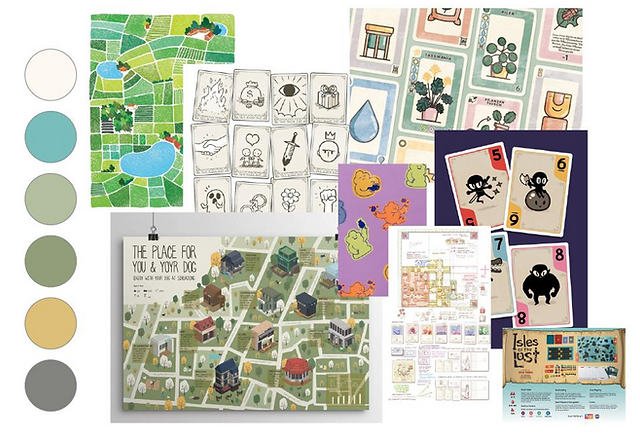
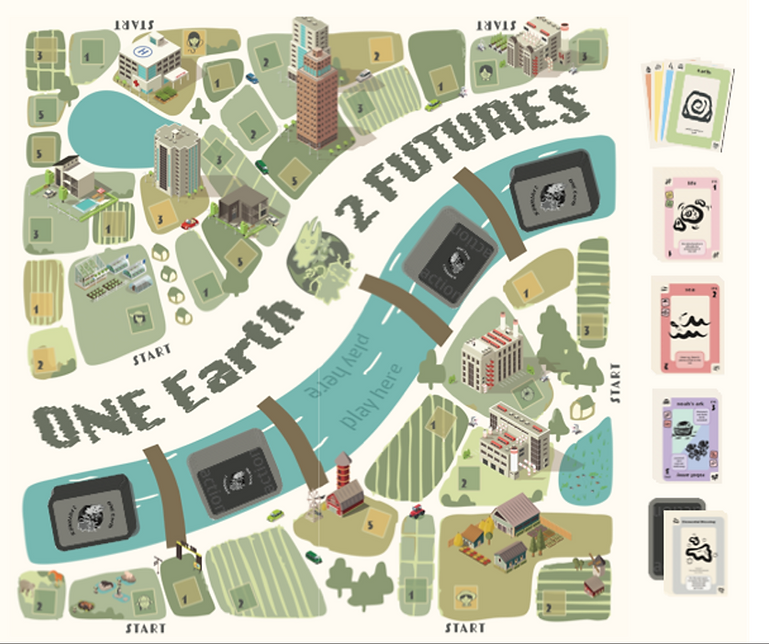
The aesthetics of One Planet: Two Futures were designed to balance optimism with tension, using a bright yet muted colour palette and hand-sketched illustrative elements to evoke a sense of imagination, possibility, and world-building. The cards, tokens, and Elementals all share a consistent visual language that feels approachable and playful, while the isometric game board adds depth and immersion without overwhelming the player. By keeping illustrations black-and-white within coloured borders, we highlighted the contrast between Nature and Technology while maintaining visual clarity during gameplay. The result is an aesthetic system that supports quick comprehension, reinforces thematic identity, and enhances the overall experience through cohesive visual storytelling.
The Game
ONE EARTH: TWO FUTURES
One Planet: Two Futures is a competitive strategy board game where players combine elemental resources to create compounds that let them expand, dominate, and invade territory on a shared world map. As players align with either Nature or Technology, every action contributes to shaping the planet’s future, blending tactical decision-making with an evolving narrative of ecological versus technological growth.
Game Board, Cards, Player Tokens and Elementals

Gameplay and Player
Experience
The gameplay of One Earth: Two Futures centres on rising tension, strategic movement, and system-driven storytelling. Players cycle through collecting, combining, and deploying resources, which feeds directly into the territory-control mechanics that shape board dominance. This structure supports both individual strategy and team coordination, offering meaningful short- and long-term decisions in line with Zubek’s (2020) idea that good design produces frequent, consequential choices. Each turn—whether expanding, dominating, or invading—creates ripple effects on positioning, access to Elementals, and faction momentum.
Clear rules and constraints allow complex interactions to emerge, reflecting the principles of emergent play. Players balance immediate gains against advanced combinations, decide how and when to use action cards, and respond to unpredictable changes in board state. The experience is enriched by emotional and social dynamics—negotiation, surprise, competition, and shifting control—echoing Fullerton’s (2019) view of dynamic systems. Limited spaces, scarce high-level compounds, and adjacency rules create constant tension between goals and obstacles, resulting in a strategic, narrative-rich experience where every choice helps determine the planet’s future.
Rules
Here are the core rules that structure how players collect resources, form compounds, and compete for control of the board.
The following is a full list of which elements combine to give compounds, and how those are used to perform different actions.